

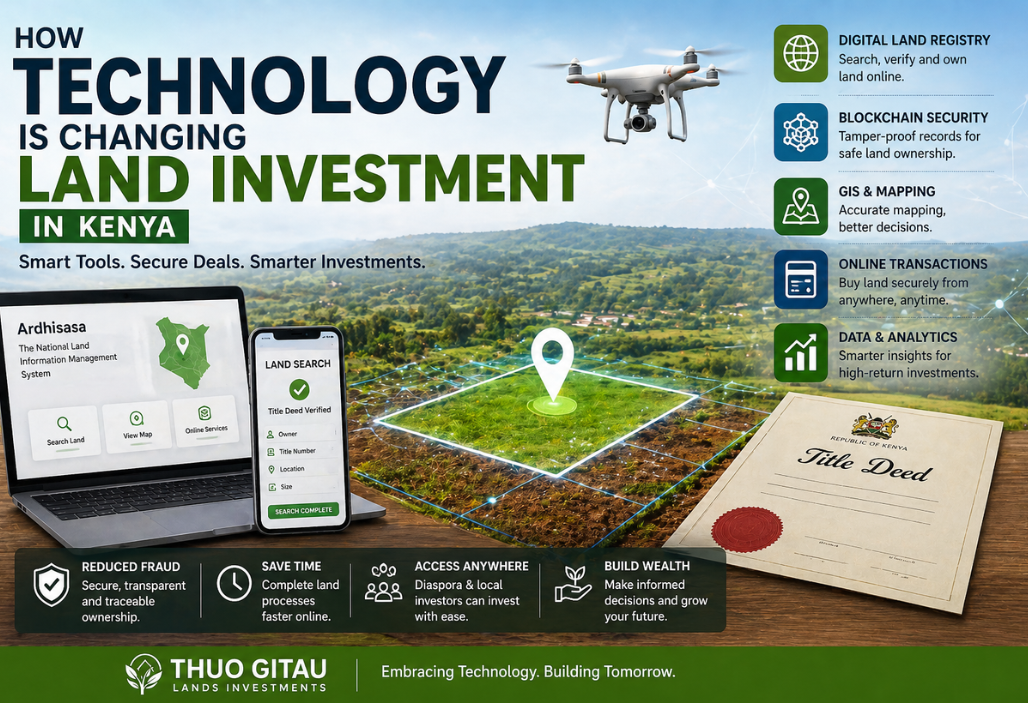
How Technology Is Changing Land Investment in Kenya.
The real estate sector is undergoing a major transformation and land investment in Kenya is no exception. What once required long queues, manual paperwork, and high risk is now becoming faster, safer, and more transparent thanks to technology.
From digital land registries to blockchain and GIS mapping, technology is reshaping how investors buy, verify, and manage land. In this article, we explore how innovation is revolutionizing land ownership in Kenya and what it means for investors.
The Rise of Digital Land Registries in Kenya.
One of the most impactful changes in Kenya’s land sector is the introduction of digital platforms like Ardhisasa under the National Land Information Management System (NLIMS).
Today, investors can:
- Conduct online land searches in Kenya
- Verify ownership in minutes
- Apply for title transfers digitally
This shift has drastically reduced the inefficiencies of manual systems, where processes took days or even weeks.
Additionally, digitization has helped reduce fraud cases by creating traceable digital records and limiting human interference.
SEO Insight: Keywords like digital land registry Kenya and online land search Kenya are now trending due to this shift.
Blockchain Technology: Securing Land Ownership.
Blockchain is emerging as a game-changer in real estate investment in Kenya. Platforms like Atlas KE are pioneering secure land ownership systems.
Blockchain technology offers:
- Tamper-proof land records
- Transparent ownership history
- Reduced risk of title deed fraud
Unlike traditional paper systems, blockchain creates an immutable digital record, meaning once data is entered, it cannot be altered or manipulated.
This is particularly important in Kenya, where land fraud—such as duplicate title deeds has historically been a major issue.
GIS Mapping and Drone Technology.
Another major innovation in property technology (PropTech) in Kenya is the use of GIS (Geographic Information Systems) and drone mapping.
These technologies allow investors to:
- View land boundaries accurately
- Analyze terrain and land use
- Identify infrastructure developments nearby
Government agencies are already leveraging drones and remote sensing to improve land surveying and data collection.
This means fewer boundary disputes and better decision-making for investors.
Convenience Through Online Platforms.
Technology has made buying land in Kenya more accessible than ever especially for diaspora investors.
With online platforms, you can:
- Browse plots for sale remotely
- Book virtual site visits
- Make digital payments
- Manage property without being physically present
Digital systems now allow 24/7 access to land records and transactions, eliminating the need for physical visits to land offices.
Reduced Fraud and Increased Transparency.
Historically, land fraud has been one of the biggest risks in Kenya’s real estate market. Cases of fake title deeds and missing files were common.
However, technology is changing this:
- Digital verification tools help confirm ownership instantly
- Online systems reduce document manipulation
- Blockchain adds an extra layer of security
In fact, digitization has already led to a significant reduction in fraudulent land transactions and improved trust in the system.
Data-Driven Investment Decisions.
Modern land investors are no longer relying on guesswork. Technology provides access to valuable data such as:
- Market trends
- Price comparisons
- Infrastructure developments
- Population growth patterns
This allows investors to identify high-growth areas in Kenya before prices skyrocket giving them a competitive advantage.
Opportunities for Diaspora Investors.
Technology has opened the door for Kenyans living abroad to invest safely back home.
With digital tools:
- You can verify land remotely
- Avoid fraud risks
- Monitor your investment in real time
This has significantly increased diaspora participation in Kenya’s real estate market.
Challenges to Watch Out For.
While technology is improving land investment, it’s not perfect.
- Some areas are not fully digitized yet
- Internet access can limit usage in rural regions
- Fraudsters are also evolving with technology
Key Advice: Always combine digital tools with physical site visits and professional due diligence.
Conclusion: The Future of Land Investment Is Digital.
Technology is no longer optional it is now central to smart land investment in Kenya. From digital registries to blockchain and GIS mapping, innovation is making land transactions:
- Faster
- Safer
- More transparent
For investors, this means reduced risk and increased confidence when buying land.