

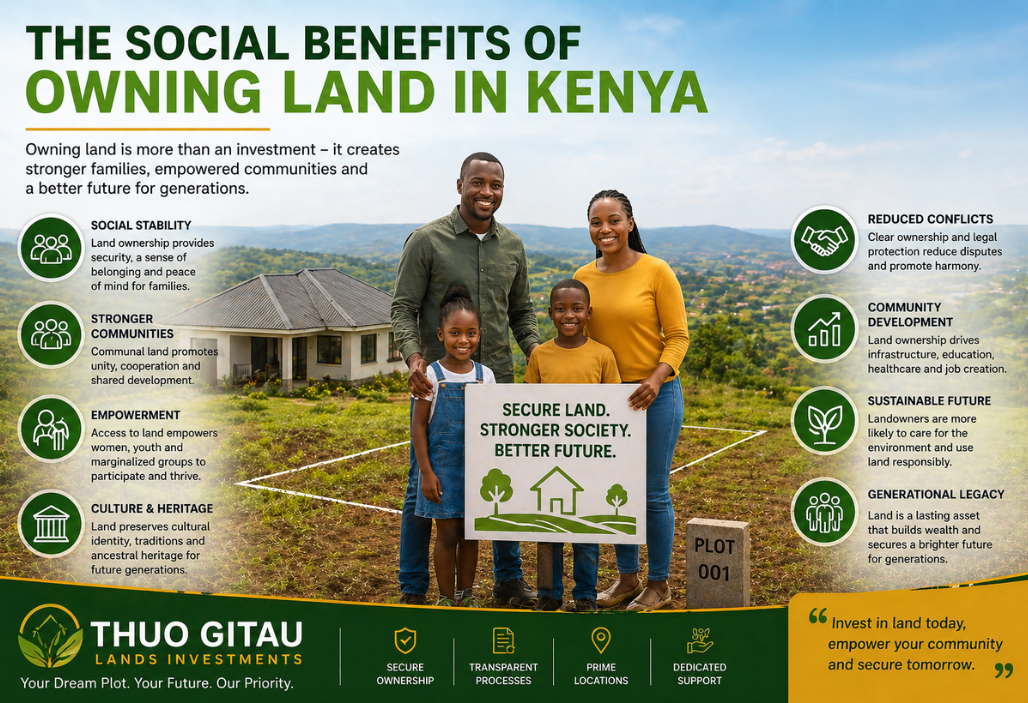
The Social Benefits of Owning Land in Kenya.
Land ownership in Kenya is often viewed purely as a financial investment but its true value goes far beyond money. Owning land plays a powerful role in shaping communities, social stability, cultural identity, and long-term security.
In this article, we explore the social benefits of owning land in Kenya and why it remains one of the most impactful assets for individuals, families, and communities.
Land Ownership Creates Social Stability.
One of the biggest advantages of owning land in Kenya is the sense of stability it provides.
Land ownership gives individuals:
- A permanent place to live
- Security from displacement
- A foundation for family development
In many Kenyan communities, land is directly linked to identity and belonging. Without land, individuals may feel economically and socially vulnerable. In fact, secure land ownership has been shown to restore dignity and independence among communities. Key Insight: Land is not just property it is a source of social security.
Strengthening Community Bonds and Social Cohesion.
Land ownership especially communal land plays a major role in building strong, united communities.
Communities that share or manage land collectively benefit from:
- Stronger social ties
- Shared responsibility
- Collective decision-making
Communal land systems in Kenya encourage cooperation in farming, grazing, and development, which strengthens unity and trust among members.
This is particularly evident in rural areas, where land is central to community life and collaboration.
Empowerment of Women, Youth, and Marginalized Groups.
Access to land ownership is a powerful tool for social empowerment.
In Kenya:
- Women are increasingly gaining legal rights to own land
- Youth are using land for entrepreneurship
- Marginalized communities are securing land rights for inclusion
Programs focused on land rights education have helped empower women, youth, and persons with disabilities by giving them legal recognition and control over resources.
When people own land, they gain:
- Decision-making power
- Economic independence
- Social recognition
Preservation of Culture and Heritage.
Land is deeply tied to culture and tradition in Kenya.
For many communities:
- Land holds ancestral value
- It is used for cultural practices and rituals
- It preserves indigenous knowledge and heritage
Secure land ownership ensures that communities can protect their traditions and pass them down to future generations. Without land, cultural identity can be lost.
Reduced Conflicts and Social Disputes.
Land disputes have historically been a major issue in Kenya. However, secure land ownership and proper registration help reduce these conflicts.
Modern land laws and systems have:
- Improved boundary clarity
- Reduced ownership disputes
- Strengthened legal protection
This leads to more peaceful communities and better social relationships.
Clear ownership = fewer conflicts + stronger communities.
Community Development and Infrastructure Growth.
Land ownership contributes directly to community development.
When individuals and groups own land, they are more likely to:
- Build homes and businesses
- Invest in schools and healthcare
- Improve infrastructure
Community land systems also allow people to pool resources for development projects, leading to shared economic and social benefits.
This creates:
- Better living standards
- Job opportunities
- Sustainable growth
Promoting Sustainable Land Use.
Landowners are more likely to care for and invest in their land responsibly.
Ownership encourages:
- Environmental conservation
- Sustainable farming practices
- Proper land management
Communities with secure land rights often develop long-term plans to protect and utilize their land effectively.
This benefits not only individuals but also the wider society.
Building Generational Wealth and Legacy.
Land ownership is one of the few assets that can be passed down through generations.
Socially, this means:
- Families maintain stability over time
- Future generations inherit security
- Wealth gaps can be reduced
Land acts as a legacy asset, ensuring that families remain rooted and empowered for years to come.
Conclusion: Land Is More Than an Investment.
While many people focus on the financial returns of land investment in Kenya, its social impact is just as important if not more.
Owning land:
- Builds strong communities
- Empowers individuals
- Preserves culture
- Promotes stability and peace