

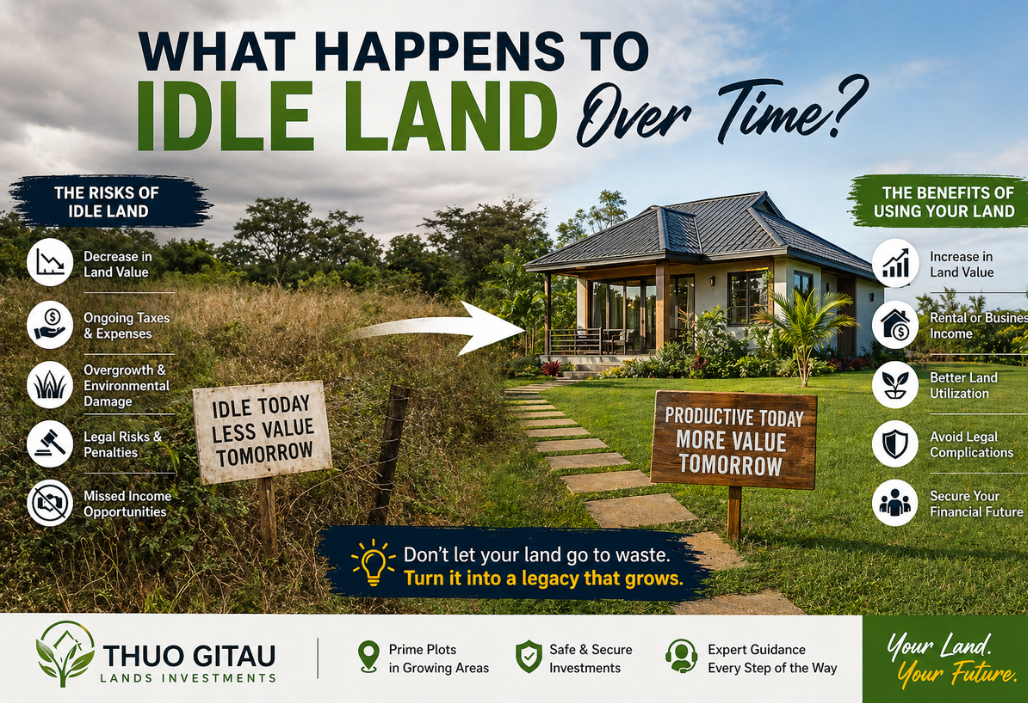
What Happens to Idle Land Over Time? (The Truth Every Investor Should Know).
Land is often considered one of the safest investments in Kenya. But what many investors don’t realize is that idle land land left unused or undeveloped does not always grow in value as expected. In fact, leaving your plot unattended for years can have both positive and negative financial, environmental, and legal consequences.
In this guide, we explore what really happens to idle land over time and how you can protect and maximize your investment.
Does Idle Land Appreciate or Depreciate?
One of the biggest assumptions in land investment in Kenya is that land always appreciates. While this is often true in high-growth areas, appreciation is not guaranteed.
- Land can increase in value due to urbanization, infrastructure development, and population growth.
- However, neglected or poorly located land may stagnate or even lose value over time due to lack of demand and poor condition.
Key Insight: Land grows in value when the area develops not simply because time passes.
The Hidden Costs of Leaving Land Idle.
Many investors assume idle land has no expenses. That’s far from the truth.
1. Ongoing Land Rates and Taxes.
Even unused land attracts land rates and property taxes, which accumulate over time and can reduce your overall return on investment.
2. Missed Income Opportunities.
Idle land means you’re missing out on:
- Rental income
- Farming or leasing opportunities
- Commercial development returns
Simply put, your land could be working for you but it isn’t.
3. Rising Maintenance Costs.
Over time, idle land may require:
- Bush clearing
- Fencing
- Soil restoration
Neglected plots often become more expensive to rehabilitate later.
Environmental Impact of Idle Land.
Leaving land unused doesn’t mean it remains unchanged. Nature takes over and not always in a good way.
- Overgrown vegetation and invasive species can dominate the land
- Soil erosion can reduce land quality and usability
- Idle land may attract pests like rodents and insects
These factors can reduce both the market value and usability of your plot over time.
Legal Risks and Government Policies.
In Kenya, idle land can also expose you to legal and regulatory risks.
- Some counties require landowners to develop land within a specific timeframe
- Failure to comply may lead to penalties or even repossession in extreme cases
Additionally, idle land contributes to:
- Delayed infrastructure development
- Artificial land price inflation
- Urban planning challenges
Governments are increasingly pushing for productive land use, meaning idle land may face stricter regulations in the future.
Land Banking vs Land Hoarding.
Holding land for future profit is known as land banking a legitimate investment strategy. However, when land remains unused for too long without clear plans, it becomes land hoarding.
The difference matters:
- Land banking: Strategic holding with future development plans
- Land hoarding: Passive holding with no economic or social value
In fast-growing regions, excessive idle land can:
- Worsen housing shortages
- Drive up land prices
- Slow down economic growth
How to Turn Idle Land into a Profitable Asset.
Instead of letting your land sit idle, consider these smart strategies:
1. Develop the Land.
Build:
- Rental units
- Holiday homes
- Commercial spaces
2. Lease It Out.
You can lease land for:
- Farming
- Parking
- Events
3. Use It for Agribusiness.
Agriculture is one of the most practical ways to generate income from idle land in Kenya.
4. Improve Its Value.
Add:
- Fencing
- Access roads
- Utilities
These improvements significantly boost resale value.
Conclusion: Idle Land Is a Risky Passive Strategy.
Owning land is powerful but leaving it idle is not always profitable. Over time, idle land can lead to:
- Hidden costs
- Missed income
- Environmental degradation
- Legal risks
The smartest investors don’t just buy land—they activate it.