

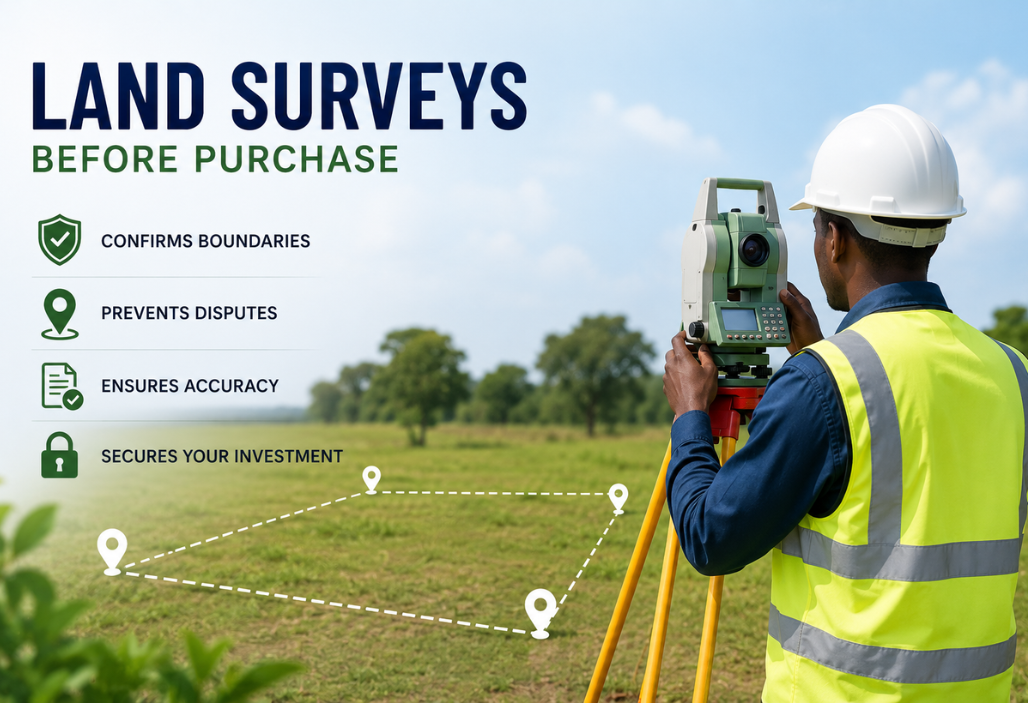
Why Land Surveys Are Important Before Purchase.
Buying land is one of the most significant investments you can make, whether for residential development, commercial projects, farming, or long-term wealth creation. However, purchasing land without conducting a professional land survey can expose buyers to costly legal disputes, inaccurate property boundaries, and financial losses.
A land survey provides accurate information about the size, shape, location, and boundaries of a parcel of land. It is an essential part of due diligence and helps buyers make informed decisions before completing a property transaction.
What Is a Land Survey?
A land survey is the process of measuring and mapping a piece of land using specialized equipment and techniques. It is conducted by a licensed land surveyor who determines the exact boundaries, dimensions, acreage, and physical features of a property.
The survey results are documented in an official survey plan, which can be used for property registration, development planning, subdivision, and resolving boundary disputes.
Why You Should Conduct a Land Survey Before Buying Land
1. Confirms the Exact Property Boundaries
One of the biggest risks when buying land is assuming that existing fences, walls, or hedges represent the true property boundaries.
A professional land survey accurately identifies where the property begins and ends, ensuring you purchase exactly what is stated on the title deed.
This protects you from future ownership disputes with neighboring landowners.
2. Prevents Boundary Disputes
Boundary disagreements are among the most common land-related legal issues in Kenya.
A land survey establishes official boundary lines and verifies the location of beacons, reducing the likelihood of conflicts after the purchase.
Knowing the exact boundaries also prevents accidental encroachment onto neighboring properties.
3. Verifies the Size of the Land
The size indicated on a title deed may differ from the actual measurements on the ground due to historical errors, illegal alterations, or outdated records.
A land survey confirms the exact acreage or dimensions, ensuring you receive full value for your investment.
4. Supports Legal Compliance
A survey helps verify that the land complies with government planning regulations and cadastral records.
It also confirms that the property’s boundaries match official records maintained by the Ministry of Lands.
This minimizes the risk of purchasing land with registration inconsistencies.
5. Identifies Encroachments
A survey can reveal whether:
- Buildings extend beyond property boundaries
- Neighbors have occupied part of the land
- Public roads or utility lines cross the property
- Easements or rights of way affect future development
Identifying these issues before purchase allows buyers to negotiate or reconsider the investment.
6. Facilitates Future Development
If you intend to build a home, commercial property, apartments, or agricultural infrastructure, a survey provides accurate measurements needed for architectural design and construction planning.
It also helps ensure compliance with county zoning and development regulations.
7. Assists with Land Subdivision
Investors planning to subdivide land require accurate survey data before applying for subdivision approvals.
Proper surveying simplifies the approval process and reduces delays during registration.
8. Increases Investment Security
Land fraud remains a concern in the real estate market.
A professional survey, combined with title verification and official land searches, significantly reduces the risk of purchasing fraudulent or overlapping properties.
Types of Land Surveys
Depending on your investment goals, different surveys may be required.
Boundary Survey
Determines the exact legal boundaries of the property.
Topographical Survey
Maps natural and man-made features such as slopes, rivers, roads, trees, and buildings.
Subdivision Survey
Required when dividing one parcel into multiple plots.
Construction Survey
Provides measurements needed before construction begins.
When Should You Conduct a Land Survey?
A land survey should be completed:
- Before signing a sale agreement
- Before transferring ownership
- Before developing land
- Before subdividing property
- Before constructing boundary walls or fences
- Whenever property boundaries are uncertain
Early surveying prevents expensive mistakes later.
Choosing a Qualified Land Surveyor
Always work with a licensed and registered land surveyor.
An experienced professional will:
- Verify boundary beacons
- Prepare accurate survey maps
- Work with government records
- Ensure compliance with Kenyan land laws
- Provide reliable documentation for future transactions
Avoid relying on informal measurements or estimates, as they can lead to costly disputes.
Additional Due Diligence Before Buying Land
While a land survey is essential, buyers should also:
- Conduct an official land search.
- Verify the title deed.
- Confirm ownership details.
- Check zoning regulations.
- Inspect access roads and infrastructure.
- Ensure there are no pending court cases or encumbrances.
- Review environmental and development restrictions.
Completing these checks protects your investment and provides peace of mind.
Conclusion
A land survey is much more than a technical exercise it is a critical safeguard for any property investment. It confirms property boundaries, prevents disputes, verifies land size, supports legal compliance, and provides the confidence needed to proceed with a purchase.
Whether you are buying land for your dream home, commercial development, agriculture, or long-term investment, never skip the surveying process. The relatively small cost of a professional survey can save you from significant legal and financial challenges in the future.