
What to Look for During a Land Site Visit in Kenya.
Buying land is one of the most rewarding investments but it can also be risky if you skip one crucial step: the land site visit. Many buyers in Kenya rely on photos, brochures, or agent descriptions, only to discover later that the land is completely different on the ground.
A proper site visit helps you verify the true condition, location, and value of the land before making any financial commitment. In this guide, we break down exactly what to look for during a land site visit in Kenya to ensure you make a safe and profitable investment.
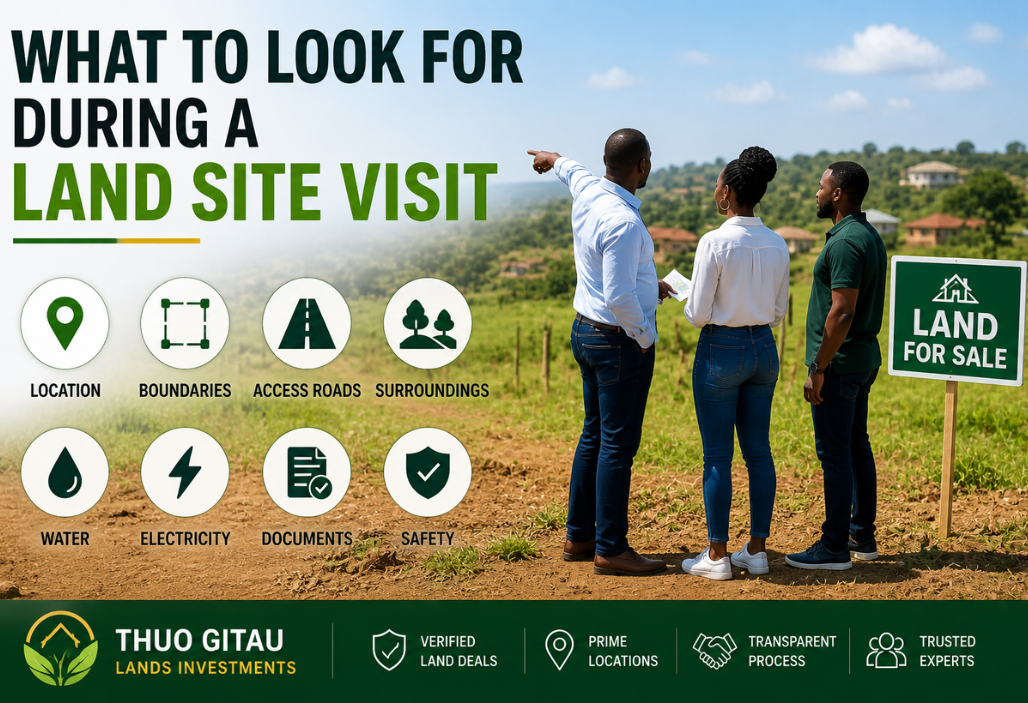
1. Confirm the Exact Location of the Land.
The first thing to verify is whether the land you are shown is actually the land being sold.
- Compare GPS location with the title details
- Ensure the plot matches what was advertised
- Avoid relying on maps or photos alone
Many land scams happen when buyers are shown a different plot than the one on the title.
Pro Tip: Always physically stand on the land before paying anything.
2. Check Beacons and Boundaries.
Beacons are physical markers that define the boundaries of the land. During your visit:
- Walk around the entire plot
- Confirm all beacons are visible and intact
- Ensure boundaries match the size on the title
Missing or unclear beacons can lead to future disputes with neighbors.
If beacons are missing, insist on a licensed surveyor to re-establish them.
3. Assess Accessibility and Road Network.
Accessibility is one of the most important factors in land investment in Kenya.
Check:
- Whether there is a clear access road
- If the road is public or private
- Road condition during rainy and dry seasons
Some plots are “landlocked,” meaning they have no legal access road making them difficult to use or resell.
Good road access = higher land value.
4. Evaluate the Surrounding Area and Neighborhood.
A land site visit is not just about the plot it’s about the environment around it.
Look for:
- Nearby developments (homes, schools, businesses)
- Security of the area
- Future growth potential
Talking to neighbors can also help you uncover important information about the land’s history and ownership.
5. Check Soil Quality and Topography.
The physical nature of the land affects its usability and cost of development.
Ask yourself:
- Is the land flat, sloping, or rocky?
- Is the soil suitable for construction or farming?
- Does the area flood during rainy seasons?
Some plots may appear attractive but turn out to be swampy or unstable leading to high construction costs.
6. Availability of Utilities and Infrastructure.
Before buying land, confirm whether essential services are available:
- Water supply
- Electricity connection
- Sewer systems or drainage
If these are not available, you may incur extra costs installing them.
Infrastructure directly affects both usability and property value.
7. Look Out for Encroachment or Occupation.
Always inspect whether the land is free from:
- Squatters
- Illegal structures
- Neighbor encroachment
Buying land with existing occupants can lead to lengthy legal battles.
8. Avoid Restricted or Risky Land Areas.
Some land may not be legally or practically suitable for development.
Be cautious of:
- Riparian land (near rivers or lakes)
- Flood-prone areas
- Land reserved for public use
Building on such land can result in legal issues or demolition.
9. Visit the Land at Different Times.
A single visit is not enough.
- Visit during the day and evening
- Check during rainy and dry seasons if possible
- Observe traffic, noise, and activity
This helps you understand the land’s true environment and lifestyle potential.
10. Cross-Check What You See with Documents.
After your site visit, ensure everything matches:
- Title deed details
- Survey maps (RIM)
- Land size and boundaries
A site visit should always be combined with legal due diligence for maximum safety.
Why a Land Site Visit Is Non-Negotiable.
A physical site visit is one of the most critical steps in buying land. Experts emphasize that relying on online listings alone can lead to costly mistakes and scams.
Seeing the land yourself allows you to:
- Verify authenticity
- Identify hidden issues
- Make informed investment decisions