

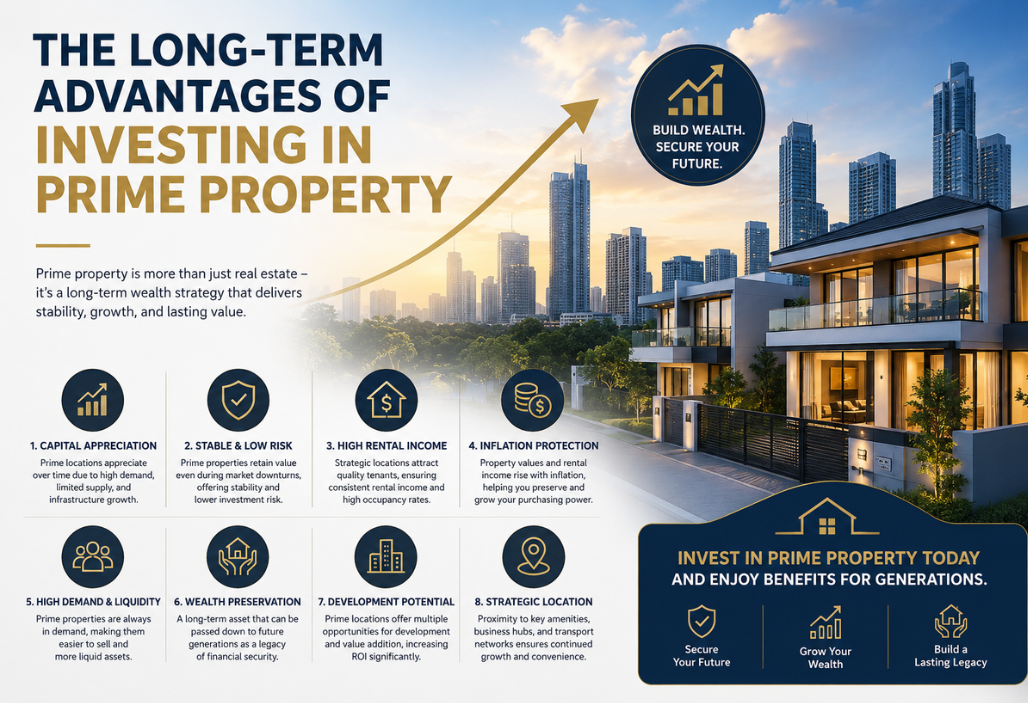
The Long-Term Advantages of Investing in Prime Property.
Investing in real estate has consistently proven to be one of the most reliable wealth-building strategies worldwide. Among the various types of real estate, prime property investment stands out due to its long-term stability, strong capital appreciation, and resilience against economic fluctuations. Whether you are a first-time investor or expanding your portfolio, understanding the long-term advantages of investing in prime property is essential for making informed financial decisions.
What Is Prime Property?
Prime property refers to real estate located in highly desirable areas with strong infrastructure, high demand, and consistent growth potential. These include urban centers, rapidly developing suburbs, and locations near key amenities such as roads, schools, business hubs, and transportation networks.
1. Strong Capital Appreciation Over Time
One of the most significant advantages of investing in prime property is long-term capital appreciation. Unlike many other investment options, land and real estate typically increase in value over time.
Prime locations tend to experience faster appreciation due to:
- Population growth
- Infrastructure development
- Urban expansion
- Increased demand for limited land
As demand rises and supply remains limited, property values in prime areas naturally escalate, making them a powerful wealth-building asset.
2. Stable and Low-Risk Investment
Prime property is widely considered a low-risk investment option compared to stocks or cryptocurrencies. While markets fluctuate, real estate in desirable locations maintains intrinsic value.
Even during economic downturns, prime properties:
- Retain high demand
- Experience minimal depreciation
- Recover value faster than non-prime locations
This stability makes them ideal for long-term investors seeking financial security.
3. High Rental Income Potential
Another major benefit of investing in prime property is the ability to generate consistent rental income. Properties located in strategic areas attract:
- Professionals
- Businesses
- Students
- Tourists (in commercial or mixed-use zones)
High occupancy rates and competitive rental pricing ensure a steady cash flow, making prime property an excellent source of passive income.
4. Protection Against Inflation
Real estate is one of the most effective hedges against inflation. As the cost of living rises, so does property value and rental income.
This means:
- Your asset value increases with inflation
- Rental income adjusts upward over time
- Purchasing power is preserved
Unlike cash savings that lose value over time, prime property maintains and grows its financial strength.
5. High Demand and Liquidity Advantage
Prime properties are always in demand due to their location advantages. This makes them easier to sell compared to properties in remote or undeveloped areas.
Key demand drivers include:
- Proximity to infrastructure (roads, rail, airports)
- Access to social amenities
- Security and urban development
- Business and commercial opportunities
This strong demand ensures that investors can exit the market more easily when needed.
6. Wealth Preservation and Generational Value
Prime real estate is often used as a long-term wealth preservation tool. Families and investors hold onto such properties for generations due to their consistent appreciation and low maintenance costs.
Benefits include:
- Long-term financial security
- Asset inheritance for future generations
- Reduced financial risk over time
It is not just an investment it is a legacy asset.
7. Opportunity for Development and Value Addition
Prime property offers multiple development opportunities that increase its value further. Investors can:
- Build residential homes
- Develop commercial spaces
- Subdivide land for resale
- Lease for business use
This flexibility enhances ROI (Return on Investment) significantly.