

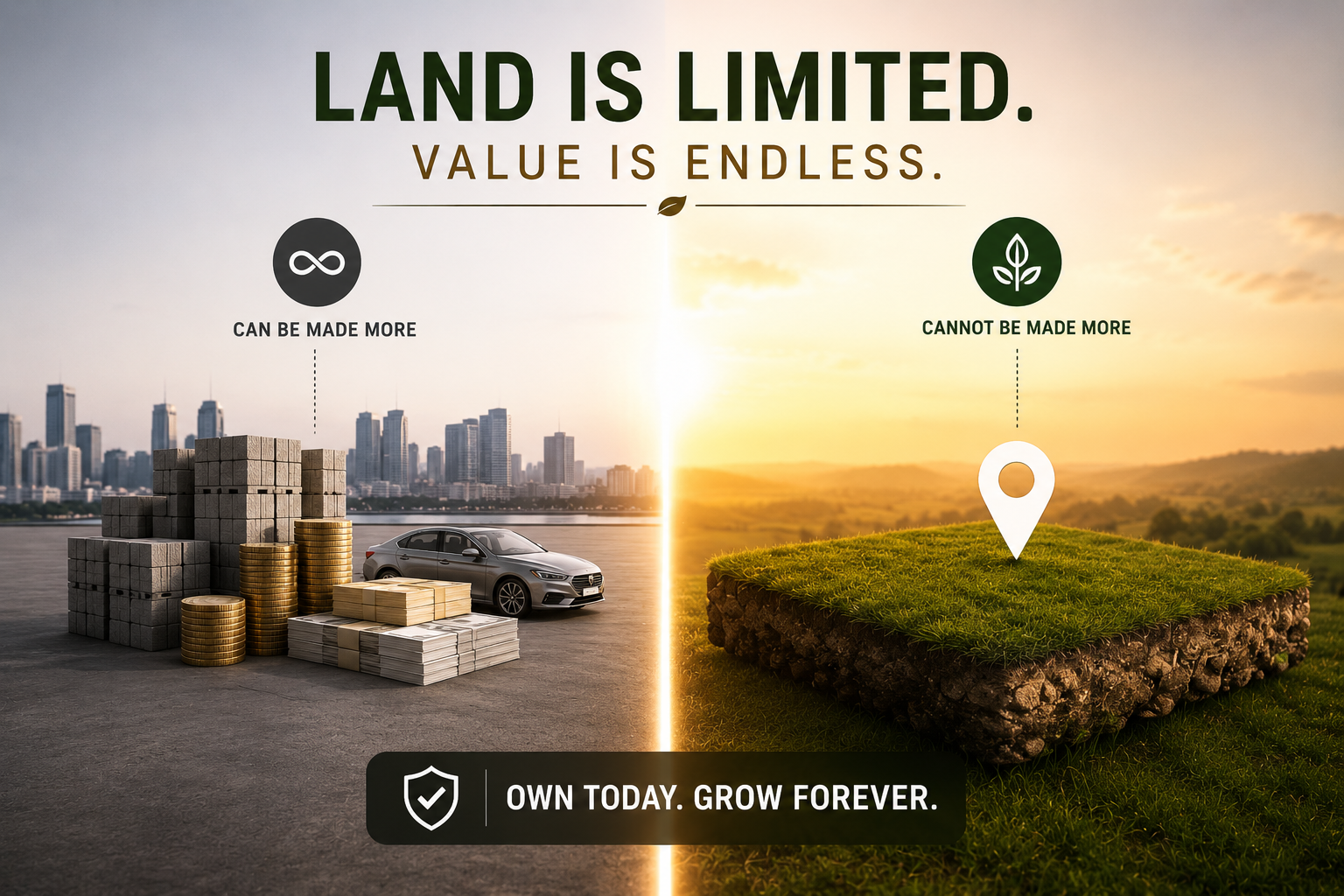
Land Is a Finite Resource.
Every successful investment is driven by one powerful principle: scarcity.
Gold is valuable because it is limited. Diamonds are expensive because they are rare. Land follows the same principle but with an even stronger advantage. Unlike many assets that can be manufactured, duplicated, or replaced, land is permanently limited. No government, company, or investor can create more of it.
That is why land continues standing out as one of the most powerful long-term investments in Kenya and across the world.
The World Is Growing but Land Is Not.
Every year, populations increase, cities expand, businesses grow, and housing demand rises. More people need places to:
- Live
- Build
- Farm
- Work
- Invest
But while human needs continue expanding, the size of the earth remains exactly the same.
This imbalance between growing demand and fixed supply is what makes land extremely valuable over time.
In rapidly developing areas around Nairobi, Kiambu, Machakos, Nakuru, and emerging satellite towns, available plots are becoming harder to find because more investors are competing for the same limited spaces.
The earlier investors secure land, the greater the future advantage.
Tomorrow’s Prime Areas Are Being Bought Today.
One of the biggest mistakes many people make is assuming undeveloped areas will always remain affordable.
History proves otherwise.
Places that were once considered “far” from the city eventually became high-demand locations after roads, businesses, schools, and residential developments expanded into them.
Areas such as:
- Ruiru
- Syokimau
- Kitengela
- Juja
- Kamulu
have experienced tremendous growth because investors recognized their future potential early.
Land that once sold cheaply in these locations now costs significantly more because development reduced availability.
This pattern continues happening across Kenya as infrastructure pushes urban growth outward.
Why Scarcity Creates Wealth.
Scarcity increases competition.
When many buyers want a limited resource, value naturally rises. This is exactly what happens with strategically located land.
People may postpone buying cars, electronics, or luxury products, but the need for land never disappears because land supports nearly every aspect of economic growth:
- Housing
- Agriculture
- Commercial development
- Transportation
- Industrial expansion
As long as populations continue growing, demand for land will always exist.
This makes land one of the few assets capable of maintaining relevance across generations.
You Can Build More Houses But Not More Earth
Developers can build apartment blocks. Companies can manufacture products. Banks can print money.
But nobody can manufacture new land in prime locations.
That uniqueness is what gives land long-term strength.
Once a strategic piece of land is occupied, developed, or sold, opportunities in that exact location become increasingly rare.
This is why investors often focus heavily on location. A well-positioned plot near:
- Infrastructure projects
- Highways
- Business centers
- Growing towns
- Bypass roads
can become significantly more valuable over time simply because availability continues shrinking.
Finite Supply Protects Long-Term Value.
Many investments lose value due to oversupply. Markets become saturated, competition increases, and prices drop.
Land behaves differently because supply remains fixed.
Even during changing economic conditions, demand for land usually remains steady because people will always require physical space for living, business, and development.
This fixed supply helps land maintain strong long-term investment value compared to assets that can easily be reproduced or replaced.
Land Ownership Is Becoming More Competitive.
Today, more young professionals, diaspora investors, businesses, and families are entering the real estate market than ever before.
People increasingly understand that land ownership offers:
- Financial security
- Long-term appreciation
- Future flexibility
- Wealth preservation
As more investors enter the market, competition for available land continues increasing.
This growing competition is one reason strategically located plots appreciate faster over time.
The Real Power of Owning Land.
Owning land is not only about possessing property.
It is about controlling a resource that becomes harder to acquire every year.
A person may delay investing today, but future buyers may pay significantly more for the same piece of land simply because:
- Population increased
- Infrastructure improved
- Businesses expanded
- Demand rose
- Supply reduced
This is why experienced investors often say land rewards patience.