

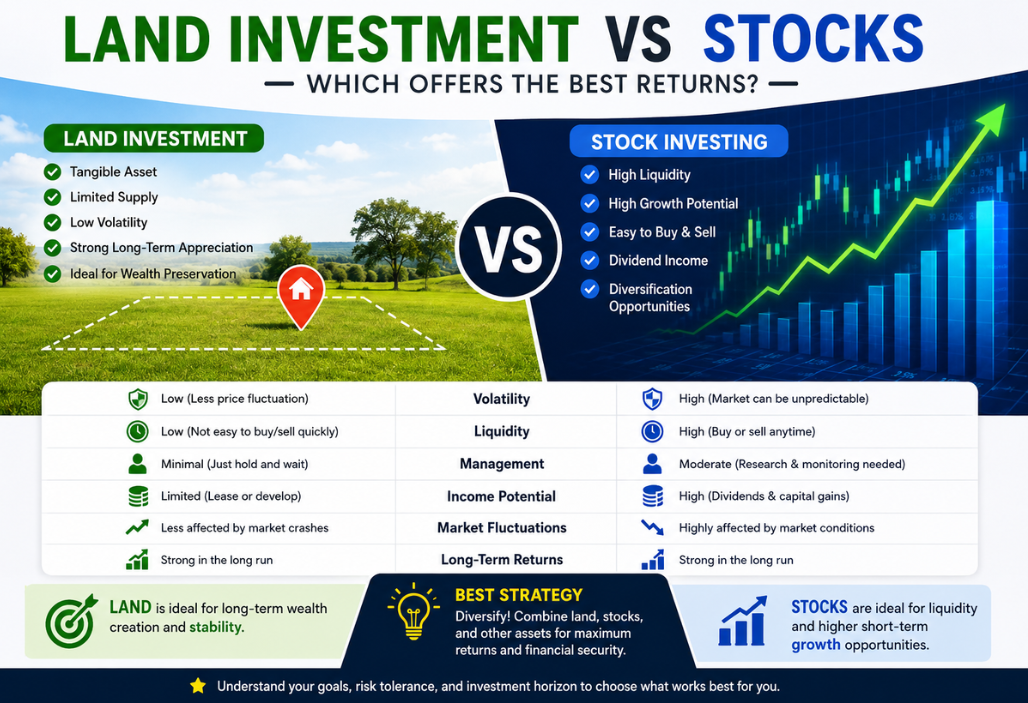
Land Investment vs Stocks: Which Offers the Best Returns?
When it comes to building wealth, two of the most popular investment options are land investment and stock market investing. Both have created millionaires, but they differ significantly in terms of risk, returns, liquidity, and long-term growth potential. For investors looking to maximize their returns, understanding the strengths and weaknesses of each asset class is essential.
In this guide, we compare land investment vs stocks, helping you determine which option offers the best returns based on your financial goals.
Understanding Land Investment
Land investment involves purchasing undeveloped or developed land with the expectation that its value will increase over time. Investors typically profit through capital appreciation, leasing, or future development opportunities.
Benefits of Land Investment
1. Strong Long-Term Appreciation
One of the biggest advantages of land is its tendency to appreciate steadily over time. As populations grow and urban areas expand, the demand for land increases while supply remains fixed.
Keywords: land appreciation, real estate investment, land value growth, property investment
2. Limited Supply Creates Value
Unlike stocks, more land cannot be manufactured. This scarcity often drives prices upward, especially in high-growth areas near infrastructure projects, highways, industrial parks, and residential developments.
3. Lower Volatility
Land prices typically experience less day-to-day fluctuation compared to stocks. Investors are less exposed to sudden market crashes, making land a relatively stable investment.
4. Tangible Asset Ownership
Owning land provides a physical asset that cannot disappear due to corporate bankruptcy or poor management decisions.
Understanding Stock Investments
Stocks represent ownership in publicly traded companies. Investors earn returns through capital gains and dividends.
Benefits of Stock Investing
1. High Growth Potential
Historically, stock markets have generated attractive long-term returns. Successful companies can multiply investor wealth significantly over time.
Keywords: stock market returns, equity investments, dividend investing, capital gains
2. High Liquidity
Stocks can be bought and sold quickly through stock exchanges, giving investors easy access to their money when needed.
3. Diversification Opportunities
Investors can spread risk across multiple industries, countries, and sectors through mutual funds and exchange-traded funds (ETFs).
4. Dividend Income
Many companies pay regular dividends, providing a consistent income stream alongside capital appreciation.
Comparing Returns: Land vs Stocks
Historical Performance
Stock markets in developed economies have historically produced average annual returns ranging between 7% and 10% after inflation over long periods.
Land appreciation varies greatly by location. Strategic land purchases in rapidly developing regions have often generated returns exceeding stock market averages, particularly when infrastructure development accelerates demand.
For example, investors who purchased land on the outskirts of growing cities often experienced property value increases of 100% to 500% within a decade due to urban expansion.
Risk Comparison
| Factor | Land Investment | Stocks |
|---|---|---|
| Volatility | Low | High |
| Liquidity | Low | High |
| Management Required | Minimal | Moderate |
| Income Potential | Limited unless leased | Dividends possible |
| Market Fluctuations | Less frequent | Daily |
| Long-Term Appreciation | Strong | Strong |
Which Generates Higher Returns?
The answer depends largely on timing, location, and investment strategy.
Land may outperform stocks when:
- Purchased in emerging growth corridors.
- Located near upcoming infrastructure projects.
- Held for long periods.
- Acquired below market value.
Stocks may outperform land when:
- Investing in rapidly growing companies.
- Markets experience prolonged economic growth.
- Investors actively diversify portfolios.
- Dividend reinvestment compounds returns.
Why Many Investors Prefer Land
Land has become increasingly attractive because it combines wealth preservation with growth potential. Unlike stocks, which can lose substantial value during economic downturns, land often maintains intrinsic value.
Investors also appreciate the security of owning a physical asset. In many developing economies, including Kenya, strategic land purchases near expanding towns, highways, and industrial zones have delivered remarkable returns over the past decade.
Keywords: land investment in Kenya, best investment opportunities, real estate wealth building, land ownership benefits
The Best Strategy: Combine Both
Rather than choosing one investment exclusively, many financial experts recommend diversification.
A balanced portfolio may include:
- Land for long-term wealth creation and stability.
- Stocks for liquidity and higher short-term growth opportunities.
- Other assets such as bonds, businesses, or real estate developments.
This approach reduces overall risk while maximizing potential returns.