

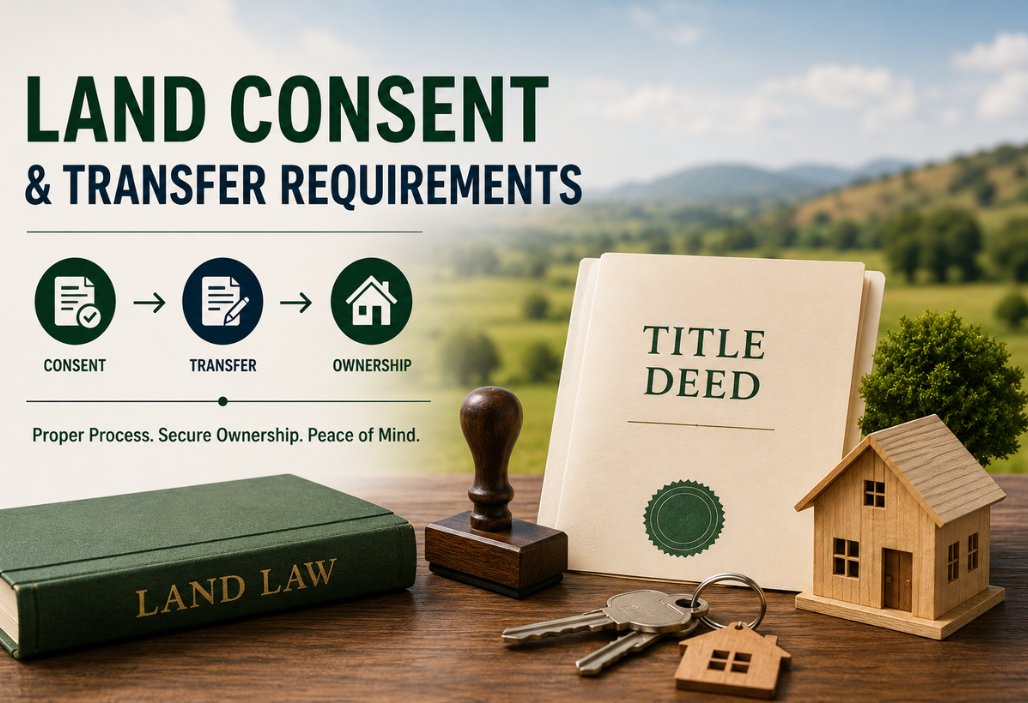
Understanding Land Consent and Transfer Requirements in Kenya.
A Complete Guide for Safe and Legal Land Ownership Transfer.
Purchasing land is one of the most rewarding investments in Kenya, but the process involves more than simply paying the purchase price and receiving a title deed. One of the most critical aspects of property transactions is understanding land consent and transfer requirements. Failure to follow the correct legal procedures can result in delays, disputes, or even loss of ownership rights.
In this guide, we explain everything land buyers and investors need to know about land consent, transfer procedures, and the legal requirements involved in acquiring land in Kenya.
What Is Land Consent?
Land consent is official approval granted by the relevant authorities before ownership of a piece of land can be transferred from one party to another. The purpose of consent is to ensure that land transactions comply with Kenyan land laws and regulations.
For agricultural land, consent is often obtained from the Land Control Board (LCB), which oversees transactions involving agricultural properties. Without the required consent, a transaction involving controlled land may be considered legally invalid.
Obtaining land consent protects both buyers and sellers by ensuring that ownership changes are properly documented and recognized by the government.
Why Is Land Consent Important?
Land consent serves several important functions:
- Verifies the legitimacy of the transaction
- Protects buyers from fraudulent land sales
- Ensures compliance with Kenyan land laws
- Facilitates smooth ownership transfer
- Prevents future ownership disputes
- Supports accurate land records and registration
For property investors, obtaining proper consent is a crucial step in securing a safe and profitable land investment.
Key Requirements Before Land Transfer
Before a land transfer can be completed, several requirements must be fulfilled.
1. Sale Agreement
The buyer and seller must sign a legally binding sale agreement outlining:
- Purchase price
- Property details
- Payment terms
- Completion period
- Obligations of both parties
It is advisable to engage a qualified advocate to prepare or review the agreement.
2. Land Search
A land search should be conducted at the Ministry of Lands to confirm:
- Ownership details
- Property size
- Existing encumbrances
- Caveats or restrictions
- Outstanding disputes
This due diligence process helps buyers avoid costly mistakes.
3. Original Title Deed
The seller must provide the original title deed and supporting ownership documents to facilitate the transfer process.
4. Land Rates and Rent Clearance
Where applicable, land rates and land rent must be cleared before transfer approval is granted.
Relevant clearance certificates may be required from county governments and the Ministry of Lands.
Understanding the Land Transfer Process
Step 1: Due Diligence
The buyer verifies ownership documents and conducts an official land search.
Step 2: Obtain Land Consent
For agricultural land, the parties apply for Land Control Board consent.
Required documents may include:
- National identification documents
- KRA PIN certificates
- Passport photos
- Sale agreement
- Application forms
Step 3: Valuation of Property
Government valuers assess the property’s market value for stamp duty purposes.
Step 4: Payment of Stamp Duty
Stamp duty is calculated based on the property’s value and must be paid before registration.
Step 5: Transfer Documentation
Transfer forms are prepared and signed by both parties.
Supporting documents may include:
- Consent letters
- Clearance certificates
- Identification documents
- KRA PIN certificates
- Passport photographs
Step 6: Registration of Transfer
The completed documents are submitted to the Lands Registry for registration.
Once approved, ownership is officially transferred to the buyer.
Step 7: Issuance of New Title Deed
The buyer receives a new title deed reflecting their ownership rights.
Common Challenges During Land Transfer
Although the process is straightforward when properly managed, buyers may encounter challenges such as:
Missing Documents
Incomplete paperwork can delay approvals and registration.
Ownership Disputes
Family disputes, succession issues, or fraudulent claims can complicate transactions.
Unpaid Land Rates
Outstanding county rates often delay transfer approvals.
Fraudulent Transactions
Unscrupulous sellers may attempt to transfer land without proper authority or documentation.
These risks highlight the importance of conducting thorough due diligence before purchasing any property.
Tips for a Smooth Land Transfer Process
To ensure a successful transaction:
- Work with reputable land investment companies
- Hire a qualified property lawyer
- Verify ownership through official land searches
- Confirm all rates and land rent are paid
- Obtain all required consents before making final payment
- Keep copies of all transaction documents
- Follow legal procedures at every stage
Taking these precautions can significantly reduce risks and delays.