

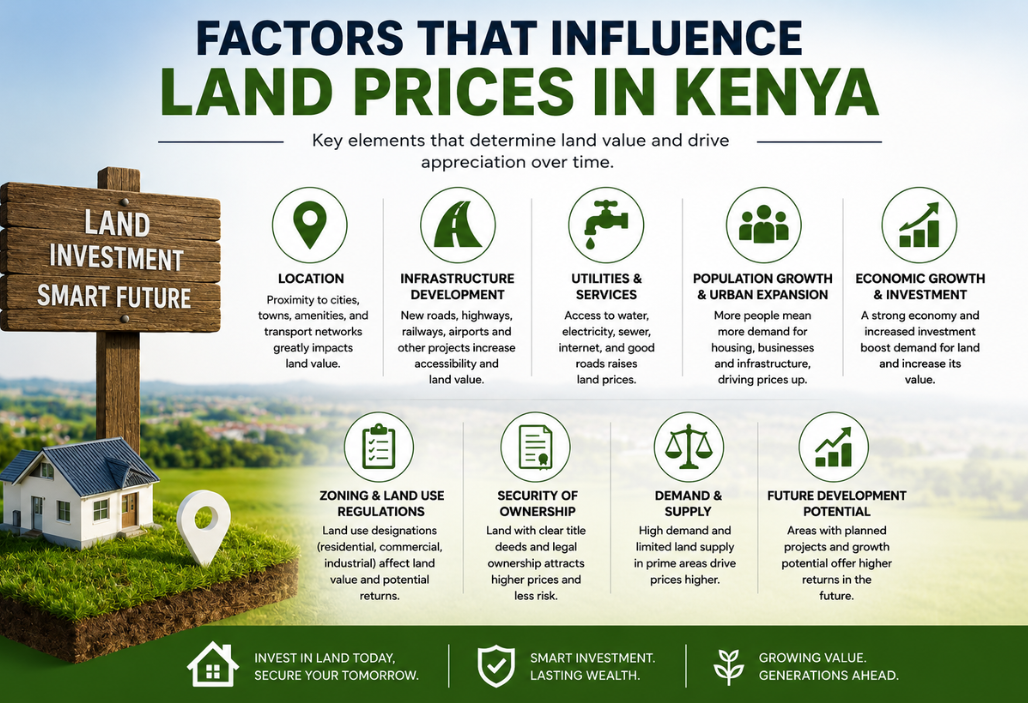
Factors That Influence Land Prices in Kenya.
Understanding What Drives Land Value.
Land remains one of the most sought-after investment assets in Kenya. Whether you are a first-time buyer, a seasoned investor, or planning to build your dream home, understanding the factors that influence land prices is essential for making informed investment decisions.
Land prices vary significantly across different regions, towns, and neighborhoods. While some areas experience rapid appreciation, others grow at a slower pace. Understanding the forces behind these price changes can help investors identify high-potential opportunities and maximize returns.
Location: The Most Important Factor
The old real estate principle, “location, location, location,” remains true when it comes to land investment in Kenya. Land situated near major towns, cities, highways, business hubs, and essential amenities typically commands higher prices.
Areas close to Nairobi, Nakuru, Kiambu, Machakos, and other rapidly growing urban centers often experience stronger demand and faster appreciation.
Investors are willing to pay premium prices for land that offers convenience, accessibility, and future development potential.
Infrastructure Development.
Infrastructure plays a major role in determining land value. New roads, highways, railways, airports, and utility services can dramatically increase land prices in surrounding areas.
When government or private sector projects improve accessibility, demand for nearby land often rises. Investors who identify areas before major infrastructure developments are announced frequently enjoy significant returns.
Examples include areas benefiting from bypass roads, dual carriageways, and industrial development projects.
Availability of Utilities and Services.
Access to essential services significantly affects land prices. Properties connected to electricity, water supply, sewer systems, internet connectivity, and good road networks are generally more valuable.
Buyers often prefer land that is ready for immediate development rather than property requiring substantial investment in infrastructure.
As a result, serviced plots typically attract higher prices than undeveloped land lacking basic utilities.
Population Growth and Urban Expansion.
Kenya’s growing population continues to increase demand for housing, commercial developments, and public facilities. As urban centers expand, neighboring areas become attractive for residential and commercial development.
This urban growth creates new investment opportunities and drives land appreciation in emerging towns and suburbs.
Locations experiencing rapid population growth often become hotspots for real estate investment due to increasing demand for land.
Economic Growth and Investment Activity.
A strong economy often leads to increased demand for real estate. When businesses expand, employment opportunities increase, and household incomes improve, more people seek land for residential and commercial purposes.
Regions experiencing industrial growth, business development, or tourism expansion typically witness higher land demand and rising property values.
Investors closely monitor economic trends because they often indicate future growth in land prices.
Zoning and Land Use Regulations.
Government regulations regarding land use can significantly influence property values. Land designated for commercial, industrial, residential, or mixed-use development may carry different price levels.
For example, commercial land along major highways or in town centers is usually more expensive than agricultural land due to its higher income-generating potential.
Investors should always understand local zoning regulations before purchasing land.
Security of Ownership and Title Deeds.
Land with clear ownership records and valid title deeds generally attracts higher prices than land with unresolved legal issues.
Buyers are increasingly prioritizing secure investments that offer legal protection and peace of mind. A clean title deed reduces the risk of disputes, fraud, and ownership conflicts.
This is why reputable land investment companies focus on offering properly documented properties to their clients.
Demand and Supply Dynamics.
Like any investment asset, land prices are influenced by market demand and supply. Areas with limited available land and high buyer demand often experience rapid price increases.
Conversely, regions with abundant land supply may experience slower appreciation rates.
As more investors compete for prime locations, scarcity drives land values upward.
Future Development Potential.
Investors do not only buy land based on its current value—they also consider future growth prospects. Planned infrastructure projects, new business parks, educational institutions, hospitals, and residential developments can significantly influence future land prices.
Areas positioned for future development often provide some of the best long-term investment opportunities.
Savvy investors frequently purchase land early in growth corridors before prices rise substantially.