

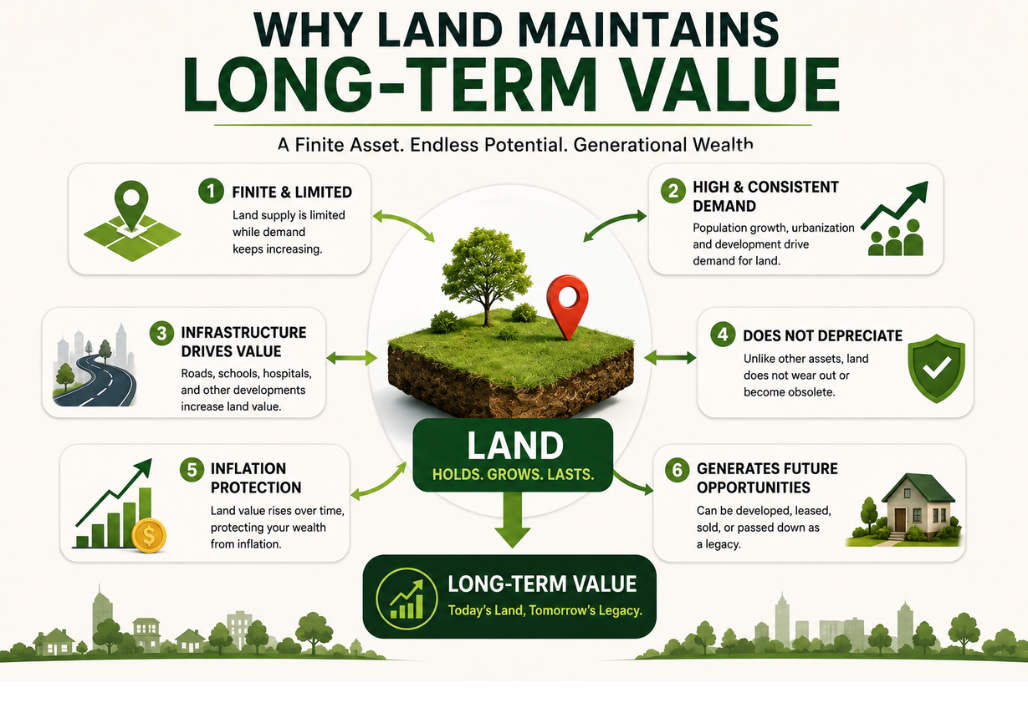
Why Land Maintains Long-Term Value.
Land has remained one of the most reliable investments for centuries because of its ability to maintain long-term value. While many assets lose worth over time due to wear, market instability, or depreciation, land continues holding and increasing its value as demand grows and development expands. This is one of the biggest reasons investors continue choosing land as a secure long-term investment.
In Kenya’s growing real estate market, land ownership is increasingly viewed as a powerful tool for wealth preservation, financial security, and generational investment. Whether purchased for future development, resale, or long-term holding, land consistently proves its ability to remain valuable over time.
Land Is a Finite Resource.
One of the main reasons land maintains long-term value is because land is limited. More people are born every day, cities continue expanding, and businesses require more space, but the amount of land available never increases.
This limited supply creates long-term demand, especially in areas experiencing:
- Population growth
- Urban expansion
- Infrastructure development
- Commercial activity
- Residential demand
As available land becomes more scarce, prices naturally rise over time. This scarcity makes land one of the strongest long-term investment assets in the real estate market.
In Kenya, areas that were once considered undeveloped have become highly valuable due to rapid growth and increasing demand for property.
Land Does Not Depreciate Like Other Assets.
Many investments lose value over time. Vehicles depreciate immediately after purchase. Electronics become outdated. Buildings eventually require repairs and renovations.
Land is different because it does not physically wear out or become obsolete. A strategically located plot can remain valuable for decades while continuing to appreciate as surrounding developments increase.
This durability helps protect investors from the rapid depreciation commonly associated with other physical assets.
Because of this stability, land is often viewed as a safer long-term investment compared to assets that lose value quickly.
Population Growth Continues Increasing Demand.
Kenya’s growing population continues creating strong demand for:
- Residential housing
- Commercial developments
- Industrial spaces
- Agricultural land
- Investment property
As towns and cities become more crowded, people continue moving toward developing areas and satellite towns in search of affordable land and housing opportunities.
This growing demand consistently supports land value appreciation over time.
Investors understand that as long as populations continue growing, the need for land will remain strong.
Infrastructure Development Increases Property Value.
Infrastructure is one of the biggest drivers of long-term land appreciation. Government projects such as:
- Highways
- Bypass roads
- Railways
- Shopping centers
- Schools
- Hospitals
often increase demand for nearby land significantly.
Improved accessibility attracts businesses, homeowners, and developers into surrounding areas, pushing property prices higher.
In Kenya, regions near major roads and bypasses have experienced rapid appreciation because infrastructure growth continues opening new economic opportunities.
This is why many investors buy land early in developing areas before prices rise substantially.
Land Offers Stability During Economic Uncertainty.
Economic conditions constantly change. Financial markets fluctuate, businesses struggle, and currencies lose value during inflationary periods. Land, however, often remains relatively stable during uncertain times.
Because land is a tangible asset with long-term demand, investors view it as a safer place to preserve wealth.
Unlike short-term investments heavily affected by market volatility, land ownership provides:
- Long-term financial security
- Wealth preservation
- Reduced investment uncertainty
- Strong future potential
This stability makes land highly attractive to both individual and institutional investors.
Land Creates Future Opportunities.
Another reason land maintains long-term value is because it creates future flexibility. Even when left undeveloped, land still holds development potential.
Owners may eventually choose to:
- Build residential homes
- Construct rental apartments
- Develop commercial spaces
- Start farming projects
- Sell at higher market value
This flexibility increases the long-term usefulness and attractiveness of land ownership.
As surrounding areas continue developing, opportunities for profitable use also increase.
Land Supports Generational Wealth.
Many families consider land one of the most important long-term assets because it can be transferred across generations while continuing to appreciate in value.
Unlike temporary investments focused on short-term profits, land ownership often becomes part of a family’s long-term financial legacy.
Parents frequently invest in land to:
- Secure their children’s future
- Preserve family wealth
- Create future development opportunities
- Build long-term financial stability
Because of its lasting nature, land continues holding cultural and economic importance across Kenya and many parts of the world.
Strategic Location Strengthens Long-Term Value.
Not all land performs equally. Location remains one of the biggest factors influencing long-term property value.
Land located near:
- Growing towns
- Transport networks
- Business centers
- Schools and hospitals
- Infrastructure projects
typically experiences stronger appreciation over time.
Smart investors focus on strategic locations where future growth potential remains high.
This is why proper research and due diligence are essential before purchasing land.