

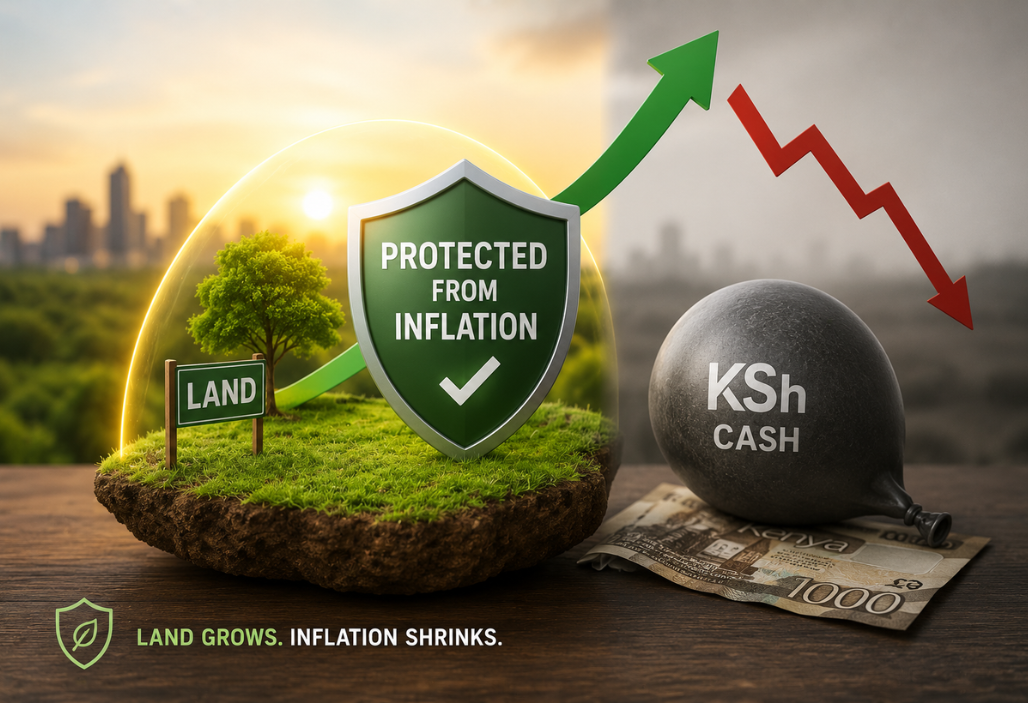
Why Land Is Protection Against Inflation.
Inflation is one of the biggest threats to financial stability. As the cost of living rises, the purchasing power of money continues to decline. What could buy a piece of land, build a home, or start a business five years ago may cost significantly more today. This is why smart investors are increasingly turning to land investment as a reliable hedge against inflation.
In Kenya’s growing real estate market, land remains one of the few assets that consistently increases in value over time. Unlike cash savings that lose purchasing power during inflationary periods, land tends to appreciate as demand, population growth, and infrastructure development continue expanding.
For investors seeking financial security and long-term wealth preservation, land investment has become one of the most effective protection strategies against inflation.
What Is Inflation?
Inflation refers to the gradual increase in prices of goods and services over time. As inflation rises:
- The value of money decreases
- Construction costs increase
- Housing becomes more expensive
- The cost of land rises
- Everyday expenses continue climbing
This means keeping large amounts of money in savings accounts without investing can slowly reduce your financial strength. According to global financial experts, real assets such as land and property often perform better during inflationary periods because their value tends to rise alongside increasing economic costs.
Why Land Performs Well During Inflation.
Land is considered a “real asset,” meaning it has physical value and limited supply. Unlike paper currency that governments can print more of, land cannot be manufactured or duplicated.
As population growth increases and urban areas expand, demand for land naturally rises. This growing demand often pushes property prices higher, especially in strategic locations near:
- Major roads
- Town centers
- Bypass corridors
- Developing satellite towns
- Commercial zones
In Kenya, areas around Nairobi, Kiambu, Machakos, Nakuru, and emerging towns have experienced significant land appreciation due to infrastructure growth and urban expansion.
Because land prices often rise alongside inflation, investors are able to preserve and grow their wealth instead of losing value through idle cash savings.
Limited Supply Increases Value.
One of the strongest reasons land protects against inflation is scarcity. Land is finite. As cities grow and populations increase, available land becomes more limited.
Kenya’s rapid urbanization has created strong demand for:
- Residential plots
- Commercial land
- Agricultural land
- Investment plots near infrastructure projects
This limited supply combined with rising demand creates long-term upward pressure on land prices. Investors who buy early in developing areas often benefit from substantial appreciation over time.
Infrastructure Development Accelerates Appreciation.
Government infrastructure projects continue playing a major role in increasing land value across Kenya. New roads, bypasses, highways, and transport networks improve accessibility and attract both businesses and residential developments.
Areas near infrastructure projects usually experience:
- Higher demand
- Faster development
- Increased commercial activity
- Rising property prices
For example, land values around bypass roads and satellite towns near Nairobi have risen significantly over the last decade because improved connectivity has made these areas more attractive for investors and homeowners.
As inflation pushes construction and housing costs upward, strategically located land continues appreciating even faster.
Land Maintains Long-Term Value.
Unlike vehicles, electronics, or many consumer products that depreciate over time, land generally maintains and increases its value over the long term.
This makes land investment particularly attractive during uncertain economic periods because:
- It offers stability
- It is less volatile than some financial markets
- It can be held for years with minimal maintenance
- It creates long-term financial security
Real estate professionals often recommend land as a long-term wealth preservation asset because it combines appreciation potential with relatively low risk.
Rental and Development Potential.
Land not only appreciates in value but also creates future income opportunities. Investors can eventually:
- Build rental apartments
- Develop commercial spaces
- Lease land for farming
- Construct warehouses
- Build residential homes
As inflation raises rental prices and property demand, developed land can generate additional passive income streams while the underlying asset continues appreciating.
This dual benefit of capital appreciation and future income generation makes land one of the strongest inflation-resistant investments available.
Why Smart Investors Choose Land.
Experienced investors understand that inflation silently erodes wealth over time. Instead of leaving money idle, they move capital into appreciating assets with long-term growth potential.
Land investment remains attractive because:
- Demand continues increasing
- Infrastructure drives appreciation
- Population growth supports long-term value
- Supply remains limited
- Property markets historically recover and grow over time