

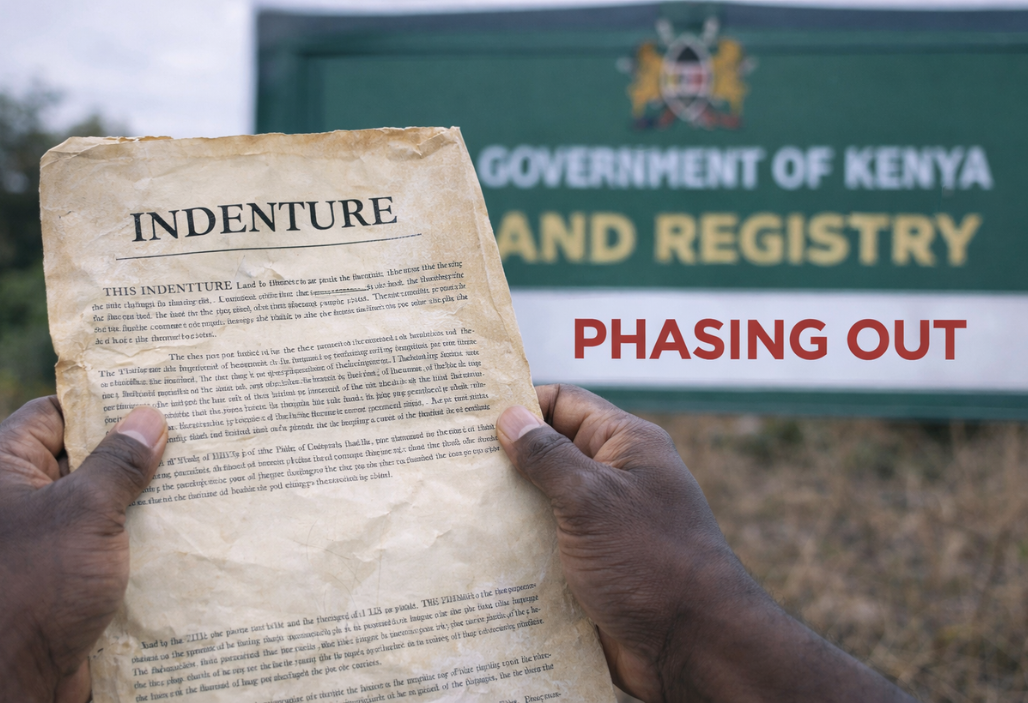
What Is an “Indenture” and Why Is the Government Phasing Them Out?
If you have ever dealt with land transactions in Kenya, especially for older properties, you may have come across the term “indenture.” While once a common legal document in land ownership, indentures are gradually being phased out as Kenya modernizes its land registration systems.
Understanding what an indenture is and why the government is replacing it is important for land buyers, sellers, and investors to avoid confusion, delays, or legal complications.
1. What Is an Indenture in Land Ownership?
An indenture is a legal document used in the past to show ownership or transfer of land. It is essentially an older form of a title deed that was widely used during the colonial and early post-independence periods.
An indenture typically includes:
- Details of the land owner
- Description of the property
- Terms of ownership or transfer
- Signatures of parties involved
- Official registration details
Unlike modern title deeds, indentures were often handwritten or typed documents and could be several pages long.
2. How Indentures Were Used in Kenya
Indentures were mainly used under earlier land registration systems such as:
- Government Lands Act (repealed)
- Registration of Titles Act (RTA)
- Indian Transfer of Property Act (historically applied)
They were common in areas like:
- Nairobi
- Mombasa
- Older municipalities
- Former colonial settlement areas
These documents served as proof of ownership before Kenya introduced more modern and standardized land registration systems.
3. Why Indentures Are Being Phased Out
The Kenyan government is gradually phasing out indentures as part of land reforms aimed at improving transparency, security, and efficiency.
1. Transition to Digital Land Records
Kenya is moving towards digitized land records to reduce fraud and improve accessibility.
Old indentures are difficult to digitize because:
- They are not standardized
- Some are handwritten or damaged
- Records may be incomplete
Replacing them with modern title deeds makes it easier to manage land records digitally.
2. Reducing Land Fraud
Indentures are more vulnerable to fraud compared to modern title deeds.
Problems with indentures include:
- Easy to forge or alter
- Missing records in registries
- Duplicate or conflicting documents
Modern land titles come with better security features and centralized registration, making fraud harder.
3. Introduction of the Land Registration Act (2012)
The Land Registration Act of 2012 introduced a unified system of land registration in Kenya.
This law:
- Replaced older land laws
- Standardized land ownership documents
- Introduced new title deed formats
- Simplified land transactions
As a result, older documents like indentures are being converted into modern title deeds.
4. Simplifying Land Transactions
Indentures can be complex and difficult to interpret, especially for new buyers.
Challenges include:
- Legal language that is hard to understand
- Multiple pages with detailed clauses
- Difficulty in verifying ownership
Modern title deeds are simpler, clearer, and easier to use during transactions.
5. Improving Land Ownership Security
Modern title deeds are more secure because they:
- Are linked to centralized government records
- Can be verified easily through land searches
- Reduce disputes over ownership
Phasing out indentures helps ensure that all land records are accurate and up to date.
4. What Happens If You Still Have an Indenture?
If your land is still registered under an indenture, you are not necessarily at risk but you may need to convert it into a title deed.
The process usually involves:
- Conducting a land search
- Confirming ownership details
- Applying for conversion at the land registry
- Issuance of a new title deed
This process is sometimes referred to as title conversion.
5. Risks of Using Indentures Today
Although still recognized in some cases, indentures can create challenges such as:
- Delays in land transactions
- Difficulty in getting financing
- Increased risk of disputes
- Challenges in verifying ownership
- Problems with land subdivision or development approvals
Many banks and buyers prefer modern title deeds over indentures.
6. What Land Buyers Should Know
Before buying land, always check:
- Whether the property uses an indenture or title deed
- Whether the document has been converted
- Whether ownership details are accurate
- Whether the land registry recognizes the document
If the land still has an indenture, it is advisable to work with a lawyer or land expert to ensure a smooth transaction.
Conclusion
An indenture is an older form of land ownership document that was widely used in Kenya before modern title deeds were introduced.
The government is phasing out indentures to:
- Improve land record management
- Reduce fraud
- Simplify transactions
- Enhance security of ownership
As Kenya continues to modernize its land systems, converting indentures into title deeds is becoming increasingly important.
For land buyers and investors, understanding these changes ensures safer transactions and protects your investment in the long run.