

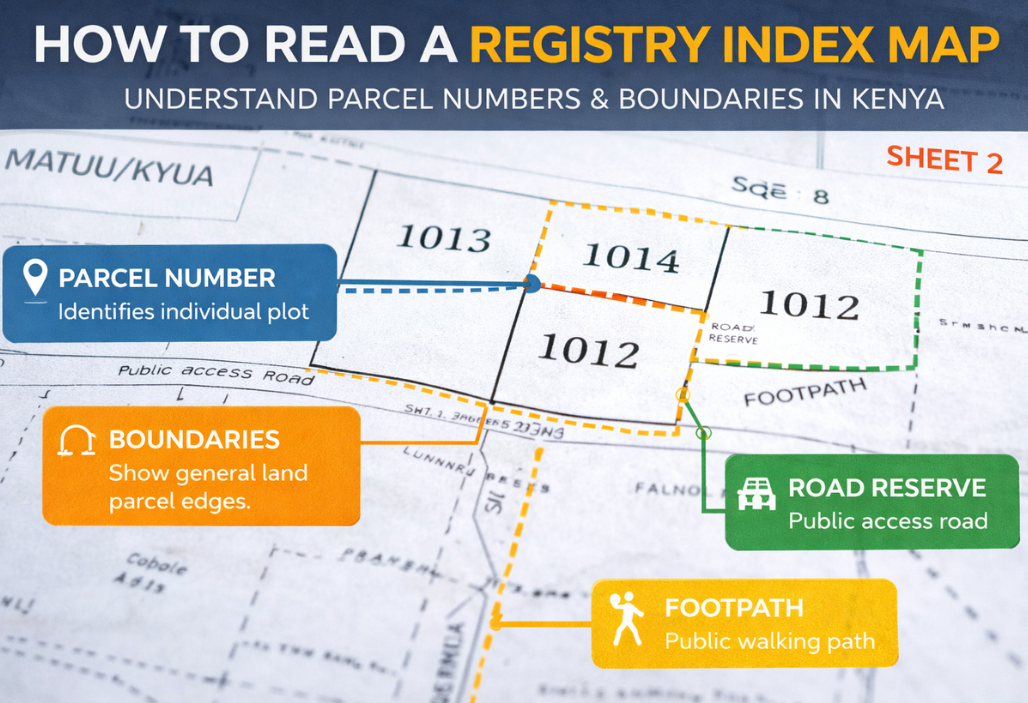
How to Read a Registry Index Map (RIM) Like a Pro
Buying land in Kenya requires more than just trusting a title deed. One of the most critical yet misunderstood documents in land transactions is the Registry Index Map (RIM). Whether you’re a first-time buyer, seasoned investor, or real estate professional, learning how to read a RIM like a pro can save you from boundary disputes, fraud, and costly legal battles.
In this guide, we break down what a RIM is, why it matters, and how to interpret it confidently especially under Kenya’s land registration framework.
What Is a Registry Index Map (RIM)?
A Registry Index Map (RIM) is an official survey map maintained by the Survey of Kenya. It shows the general location, shape, and relative position of land parcels within a registered section. Unlike mutation forms, a RIM does not show exact ground measurements, but it is legally recognized for parcel identification.
RIMs are primarily used in areas registered under the Registered Land Act (now repealed) and retained under the Land Registration Act (LRA).
Why the RIM Is Critical When Buying Land
Before purchasing land, verifying it on the RIM helps you:
- Confirm the existence of the parcel number
- Identify neighbouring plots
- Detect overlaps, encroachments, or road reserves
- Confirm if land falls within a planned or surveyed area
- Avoid buying land that exists only “on paper”
In hotspots like Ruiru, Juja, Kitengela, Joska, Matuu, and Nanyuki, RIM verification is a must due to rapid subdivision and speculative selling.
Key Components of a Registry Index Map Explained
To read a RIM like a pro, you need to understand its core elements:
1. Parcel Numbers
Each plot is assigned a unique parcel number. This number must match:
- The title deed
- Official search records
- Mutation forms (if applicable)
If the parcel number doesn’t appear on the RIM, treat the transaction as a red flag.
2. Section and Sheet Numbers
RIMs are divided into registration sections and map sheets. Always confirm:
- The section name (e.g., Ruiru East, Juja Farm)
- The correct sheet number
This ensures you’re reviewing the right map, not a neighbouring area.
3. Parcel Boundaries
Boundaries on a RIM are drawn as general boundaries, not fixed ones. This means:
- They show approximate positions
- They are not suitable for fencing without a ground survey
For precise boundaries, a licensed surveyor’s beacon certificate is required.
How to Match a RIM with the Actual Land on the Ground
Reading a RIM alone is not enough. Professionals always combine it with ground verification.
Step 1: Obtain the Official RIM
Request a certified copy from:
- The Survey of Kenya
- The Land Registry
Avoid relying on photocopies provided by sellers.
Step 2: Engage a Licensed Surveyor
A surveyor will:
- Overlay the RIM with ground features
- Identify access roads, beacons, and public utilities
- Confirm the parcel’s true position
Step 3: Compare with the Mutation Form
If the land was subdivided:
- Ensure the mutation is approved
- Confirm new parcel numbers appear on the updated RIM
Unregistered mutations are a major source of land fraud in Kenya.
Common Mistakes Buyers Make When Reading RIMs
Even experienced investors make these costly errors:
- Assuming RIM boundaries are exact
- Ignoring road reserves and public land
- Buying land not yet reflected on the RIM
- Confusing parcel numbers between adjacent sections
- Skipping professional survey verification
Avoid shortcuts. RIM interpretation is both a technical and legal process.
RIM vs Title Deed: What’s the Difference?
| RIM | Title Deed |
|---|---|
| Shows parcel location | Shows ownership |
| Issued by Survey of Kenya | Issued by Land Registry |
| Indicates boundaries generally | Confirms legal rights |
| Cannot prove ownership alone | Must match RIM |
A clean title without RIM confirmation is incomplete due diligence.
Final Thoughts: Read the RIM, Protect Your Investment
Understanding how to read a Registry Index Map like a pro gives you a major advantage in Kenya’s competitive land market. It helps you verify authenticity, avoid disputes, and make informed investment decisions.
Before committing to any land purchase, always:
- Verify the RIM
- Conduct an official land search
- Engage professionals
At Thuo Gitau Land Investment Company Limited, we ensure all our properties are fully verified on the RIM, legally compliant, and ready for secure ownership.