

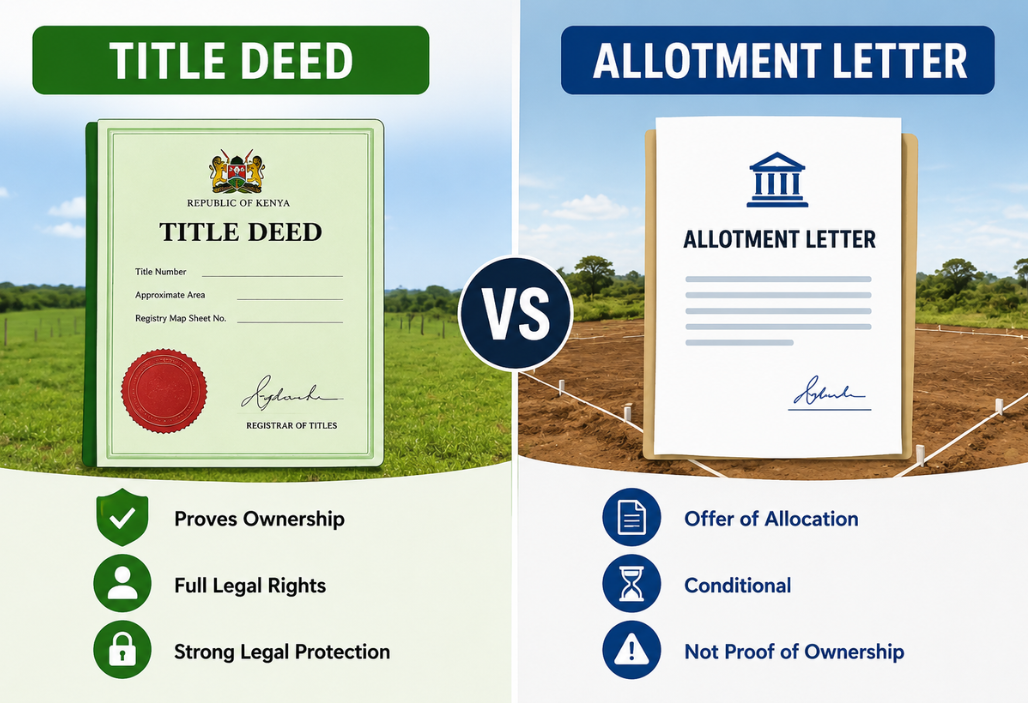
The Difference Between a Title Deed and an Allotment Letter.
Buying land is one of the most rewarding investments you can make in Kenya. However, many buyers especially first-time investors often confuse a title deed with an allotment letter. While both documents relate to land ownership, they serve very different legal purposes.
Understanding the distinction between these two documents is essential for making informed investment decisions and avoiding costly land disputes. At Thuo Gitau Lands Investments, we encourage every buyer to carry out proper land due diligence before purchasing any property.
What Is an Allotment Letter?
An allotment letter is an official document issued by the government or a legally authorized allocating authority offering a specific parcel of public land to an individual, company, or institution. It outlines the conditions under which the land may be allocated.
An allotment letter typically includes:
- The allottee’s name
- Plot or parcel reference number
- Land location
- Plot size
- Land use conditions
- Premium and fees payable
- Ground rent (where applicable)
- Conditions that must be fulfilled within the specified period
It is important to understand that an allotment letter is an offer of allocation not proof of ownership. The recipient must meet all stated conditions, pay the required charges, and complete the legal registration process before ownership can be formalized.
What Is a Title Deed?
A title deed is the official legal document issued after land has been properly registered under Kenyan land laws. It confirms the registered proprietor’s ownership rights over a specific parcel of land.
A title deed contains important information such as:
- Registered owner’s name
- Parcel number
- Land size
- Registration details
- Date of registration
- Official land registry records
Unlike an allotment letter, a title deed provides legally recognized evidence of ownership and gives the holder the right to occupy, transfer, lease, develop, or sell the property, subject to applicable laws and any registered restrictions.
Key Differences Between a Title Deed and an Allotment Letter
| Feature | Allotment Letter | Title Deed |
|---|---|---|
| Purpose | Offers allocation of land | Confirms legal ownership |
| Ownership Status | Does not prove ownership | Legally proves ownership |
| Issued By | Government or allocating authority | Land Registry after registration |
| Transfer Rights | Limited until registration | Full legal transfer rights |
| Legal Protection | Conditional | Strong legal protection |
| Registration | Requires further processing | Final ownership document |
The most significant difference is that a title deed confirms ownership, while an allotment letter merely begins the process that may eventually lead to ownership if all legal requirements are satisfied.
Can You Buy Land With Only an Allotment Letter?
The answer is yes but with caution.
Some legitimate land transactions involve allotment letters, particularly in newly allocated government land or certain settlement schemes. However, buying land that has only an allotment letter carries greater risk than purchasing land with a registered title deed.
Before proceeding, buyers should verify:
- The authenticity of the allotment letter.
- Whether all required premiums, rents, and fees have been paid.
- Whether the allocation remains valid.
- Whether the land has already been surveyed and registered.
- Whether the seller is the lawful allottee.
- Whether there are competing claims or disputes.
Professional legal advice is strongly recommended before purchasing such land.
Risks of Relying Solely on an Allotment Letter.
Purchasing land based only on an allotment letter without proper verification may expose buyers to several risks, including:
- Double allocation of the same parcel.
- Fraudulent or forged allotment letters.
- Expired allocation offers.
- Failure to meet allocation conditions.
- Delays in title processing.
- Ownership disputes.
- Difficulty obtaining financing using the land as collateral.
These risks highlight the importance of conducting comprehensive land due diligence before making any payments.
How to Verify Land Before Buying
Whether purchasing land with an allotment letter or a title deed, buyers should complete several verification steps:
Conduct an Official Land Search
An official search at the Ministry of Lands helps confirm the ownership status and reveals any cautions, restrictions, charges, or encumbrances affecting the property.
Verify the Seller’s Identity
Confirm that the seller is the registered owner or the legally authorized allottee with the right to transfer the property.
Review Supporting Documents
Request supporting documents such as:
- National ID
- KRA PIN Certificate
- Survey plan or mutation forms (where applicable)
- Payment receipts for premiums and land rent
- Land Control Board consent where required
- Sale agreement prepared by a qualified advocate
Visit the Property
A physical site visit allows buyers to confirm:
- Boundaries
- Road access
- Existing developments
- Neighbourhood characteristics
- Occupation status
Why Working With a Trusted Land Investment Company Matters
Buying land involves more than signing documents. Reputable firms like Thuo Gitau Lands Investments help buyers navigate the entire process by:
- Conducting ownership verification.
- Confirming legal documentation.
- Facilitating professional due diligence.
- Providing transparent transactions.
- Guiding buyers through title transfer procedures.
This significantly reduces the risk of fraud and gives investors greater confidence in their purchases.
Final Thoughts
A title deed and an allotment letter are not the same. An allotment letter represents an offer to allocate land, while a title deed is the final legal proof of ownership. Confusing the two can expose buyers to unnecessary legal and financial risks.
Before investing in land, always verify the authenticity of all documents, conduct an official land search, consult qualified professionals, and complete proper due diligence. These steps will help safeguard your investment and ensure that your property rights are legally protected.