

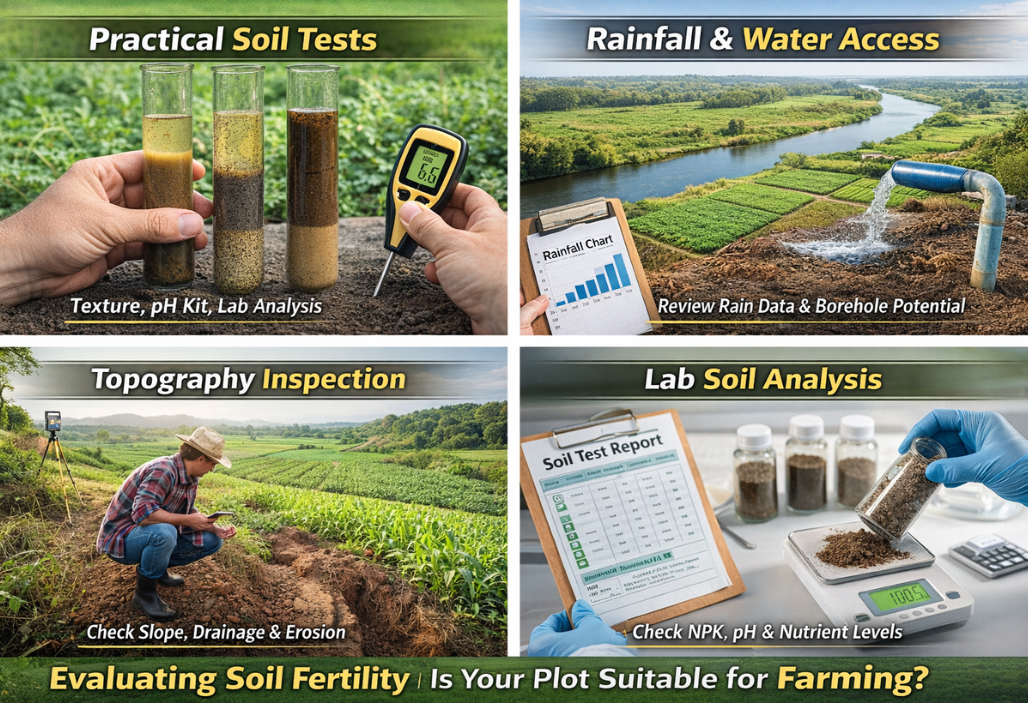
Evaluating Soil Fertility: Is Your Plot Suitable for Farming? Why Location Matters
When you buy a plot for agriculture, soil fertility is central but it doesn’t exist in a vacuum. Location (climate, water sources, altitude and infrastructure) shapes soil health, crop choices, and long-term farm productivity. This guide walks you through practical soil-fertility checks, simple tests, and the location factors that decide whether your plot is farm-ready or needs investment.
Why soil fertility and location go hand-in-hand
Soil fertility determines nutrient availability, water retention, and crop yields. Location affects:
- Climate & rainfall patterns — which crops will thrive and how often you’ll irrigate.
- Topography — slopes affect erosion risk and drainage.
- Water access — proximity to rivers, boreholes or piped supply determines irrigation cost.
- Surrounding land use — neighbouring farms, industry or urban expansion can affect soil contamination and market access.
Even nutrient-rich soils can fail without the right climate or water. Conversely, moderately fertile soils in prime locations with irrigation and markets can deliver strong returns.
Basic soil properties to evaluate (quick checklist)
- Texture — sand, silt, clay mix; affects drainage and root growth.
- pH (acidity/alkalinity) — affects nutrient availability (most crops prefer pH 5.5–7.5).
- Organic matter — higher organic content improves fertility and water-holding capacity.
- Nutrient levels — Nitrogen (N), Phosphorus (P), Potassium (K) are primary; also check calcium, magnesium, and micronutrients.
- Structure & compaction — compacted soil limits root penetration and water infiltration.
- Contamination — look for heavy metals, industrial runoff or pesticide residues in risky locations.
Practical soil testing; do these three tests first
- DIY jar test (texture): Put a soil sample in a jar with water, shake, let settle. Sand settles fastest, silt next, clay last. This tells you drainage tendencies.
- pH test kit: Affordable field kits or $5–$15 digital testers reveal acidity/alkalinity. Adjust with lime (to raise pH) or sulfur (to lower pH).
- Laboratory soil analysis: For a reliable plan, send samples to an accredited lab to measure NPK, organic matter, CEC (cation-exchange capacity) and micronutrients. Labs also provide fertilizer recommendations.
Location-specific checks you can’t skip
- Rainfall reliability: Review long-term rainfall for the area. Erratic rains mean you’ll need irrigation.
- Water rights & borehole feasibility: Confirm groundwater, borehole costs, and county permits.
- Slope & erosion risk: Steep plots require terraces or soil conservation works.
- Access to markets and inputs: Proximity to roads, agro-input shops and buyers affects profitability.
- History of land use: Past industrial, mining or intensive horticulture can leave contaminants; get a contamination screen if history is unclear.
Improving marginal soils; practical fixes
- Build organic matter with compost, manure, cover crops and green manures.
- Use targeted fertilization guided by lab recommendations (avoid blanket NPK applications).
- Improve drainage with contouring or raised beds on heavy soils.
- Adopt conservation farming: minimal tillage, mulching, and agroforestry to stabilize soils.
- Test and treat for specific contaminants where needed; remediation may be costly but essential.
Quick farmer’s checklist before you buy
- Collect 5–10 soil samples across the plot and send for lab analysis.
- Test pH on-site and do a jar texture test.
- Check historical rainfall and water-source options.
- Inspect topography and erosion signs.
- Confirm access roads, markets and county permits.
Final thought
Soil fertility is a deal-maker but location tells the full story. A scientifically tested soil sample plus a location assessment (water, climate, markets) will tell you whether a plot is farmable now, needs investment, or is better suited for other uses. For targeted assessments and help sourcing farm-ready plots, contact Thuo Gitau Lands Investments for a farm suitability report tailored to your budget and crop goals.